
The Supreme Court has agreed to urgently hear the bail plea of advocate Surendra Gadling, who has been incarcerated for seven-and-a-half years in the 2018 Elgar Parishad-Maoist links case, with the hearing scheduled for next week.

Chief Justice of India Surya Kant has recused himself from hearing petitions challenging the constitutional validity of the 2023 law regarding the appointment of election commissioners, citing a potential conflict of interest.
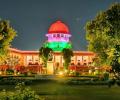
The Supreme Court has declined the Centre's request to postpone the hearing on petitions challenging the constitutional validity of the 2023 law, which excludes the CJI from the committee responsible for appointing election commissioners, stating the matter is of utmost importance.

The Supreme Court has provided significant relief to Congress leader Rahul Gandhi by directing the Allahabad High Court to cease proceedings in a case alleging disproportionate assets against him. The apex court also instructed the CBI and ED not to submit any reports based on the high court's previous directives.
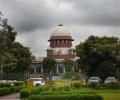
The Supreme Court has directed the deletion of a Kerala High Court order that placed the state Waqf Board under the supervision of a joint secretary, thereby restoring the Board's autonomy. The apex court modified the high court's interim order, allowing the joint secretary to remain a board member but removing any supervisory capacity.

The Supreme Court has urged the CBSE to reconsider the implementation of its three-language policy for Class 9 students, emphasising that children should not be subjected to undue pressure. The court highlighted concerns about infrastructure, the starting point of the policy, and the definition of 'native' languages.

A new digital political phenomenon, the 'E20 Janta Party', is gaining traction on Instagram, mobilising Gen Z against the government's mandatory 20% ethanol-blended petrol (E20) and demanding Union Minister Nitin Gadkari's resignation.

The Supreme Court has allowed former West Bengal chief minister Mamata Banerjee and others to file fresh applications regarding their claim that victory margins were less than the deletion of votes during the Special Intensive Revision of electoral rolls.

The Delhi Police has strongly defended its use of force during the 'Chalo Sansad' protest on July 20, telling the Supreme Court that the agitation was 'hijacked by anti-social elements and history-sheeters,' leading to law and order breakdown and over 240 police personnel injuries.

Delhi Police has implemented extensive security and surveillance measures across the national capital in anticipation of the second protest by the Cockroach Janta Party (CJP) at Jantar Mantar. The protest, led by CJP founder Abhijeet Dipke, has received permission and is expected to draw supporters from various regions, prompting the deployment of CCTV cameras, body-worn cameras, barricades, and reserve forces to ensure peace and order.
The Supreme Court has directed all states and Union territories to provide comprehensive information on acid attack cases, including case status, victim details, and rehabilitation measures.

The integration of artificial AI-based judicial assistance tools into the district court management framework has accompanied the shift.
In a landmark decision, the Supreme Court of India has quashed the 2021 Office Memorandum allowing retrospective environmental clearances, reinforcing the importance of prior environmental approval for projects but held that the judgment will apply prospectively, thus saving projects that got retrospective ECs from demolition and other punitive measures.

The Delhi high court ordered the restoration of the Cockroach Janta Party's X handle on Tuesday after the Centre informed it that the account was withheld to prevent "chaos" ahead of the NEET re-test and that there would be no difficulty revoking it now.

Indian para-badminton players, including Tokyo Paralympic champion Krishna Nagar, delivered an outstanding performance at the French Para Badminton International, securing multiple gold, silver, and bronze medals across various categories.

The Supreme Court has questioned the amended constitution of the Shiv Sena, observing that it appeared to have made the party 'virtually a one-person structure' and raising concerns about democratic functioning within political parties.

The BJP has accused West Bengal Chief Minister Mamata Banerjee of attempting to separate the state from India by inciting violence and protecting illegal immigrants, drawing parallels to the 1905 partition of Bengal.

The Supreme Court has sought the Centre's response on a petition challenging the constitutional validity of polygamy among Muslims, arguing it violates fundamental rights and creates legal asymmetry by exempting Muslim men from bigamy laws applicable to other citizens.

The Supreme Court has directed the Reserve Bank of India to prepare a standard operating procedure (SOP) within four weeks to deal with bank accounts linked to cyber frauds, including mule accounts. This directive is part of a broader effort to strengthen responses to cyber-enabled financial frauds, with the court also urging states and UTs to adopt and operationalise grievance redressal and money restoration modules.

The Supreme Court has directed the Central Bureau of Investigation (CBI) to examine all six allegations of financial irregularities levelled by the Enforcement Directorate against Sameer Gehlaut, former chairperson of Indiabulls Housing Finance (IHFL), and five corporate groups, following repeated criticism of investigating agencies for lack of progress.
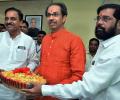
The Supreme Court is deliberating whether a split in the Shiv Sena could originate in the legislature party and then extend to the broader organisation and primary membership, as it hears pleas from the Uddhav Thackeray faction challenging the Election Commission's recognition of the Eknath Shinde-led faction.

The Uddhav Thackeray faction has told the Supreme Court that the Election Commission's decision to recognise the Eknath Shinde-led unit as the "real Shiv Sena" and grant it the 'bow-and-arrow' symbol was unlawful. Senior advocate Kapil Sibal argued that a split in a legislature party cannot, by itself, amount to a split in the political party, challenging the very basis of the poll panel's jurisdiction and its disregard for the party's 2018 constitution.

Shiv Sena (UBT) chief Uddhav Thackeray and MNS president Raj Thackeray have announced a joint 'morcha' (protest march) in Mumbai on July 26 to express solidarity with students protesting the NEET paper leak and alleged police atrocities.

The Supreme Court has sought responses from the Centre and States regarding a plea alleging the misuse of Aadhaar cards as proof of citizenship, domicile, and residential address. The petition argues that despite legal provisions, Aadhaar is being used for purposes beyond identity verification, potentially aiding illegal immigrants, and calls for a comprehensive overhaul of electoral verification processes.

The Supreme Court, hearing pleas on the Shiv Sena split, observed that a political party retains control over its legislature wing and its valid decisions must prevail, but also advocated for granting 'elbow room' to elected representatives for political decisions if a majority 'genuinely disagree' with party directions.

The observations came from a bench of Chief Justice Surya Kant and Justice Joymalya Bagchi which was hearing pleas questioning the validity of Section 152 of the Bharatiya Nyaya Sanhita (BNS).
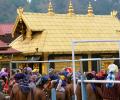
The Travancore Devaswom Board (TDB), managing the Sabarimala temple, argued in the Supreme Court that religious beliefs should be judged subjectively by the community, as the court hears petitions related to discrimination against women at religious places.

The Supreme Court of India has strongly criticised comedian Samay Raina and YouTubers Ranveer Allahbadia and Ashish Chanchlani for failing to comply with its previous order regarding disability awareness. The court expressed dismay over Raina's non-compliance and his alleged insensitive remarks about persons with disabilities, urging the Centre to consider a stringent law against such derogatory comments.
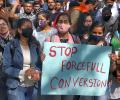
The Supreme Court has agreed to hear a plea challenging the validity of the Rajasthan Prohibition of Unlawful Conversion of Religion Act, 2025, potentially impacting religious freedom and state legislation.

The Supreme Court on Monday asked the Uttar Pradesh government to apprise it about the possibility of setting up an SIT to probe the alleged embezzlement of donations at the Ram temple in Ayodhya and cautioned the litigants not to politicise the issue.

The Supreme Court highlighted the critical need to protect forests across India, specifically mentioning states like Jharkhand for their natural ecosystems. The court declined to interfere with a Jharkhand High Court order concerning regulations for stone mining and crushers near forest boundaries, asserting the High Court's constitutional authority in the matter.

The Cockroach Janta Party (CJP) on Tuesday accused the Centre of resisting the Supreme Court's bid to facilitate quashing of FIRs against students and protesters and demanded that the outfit's members be included in the high-powered committee announced by the court to examine allegations of police excesses and violence against cops.

The Supreme Court is set to hear a batch of petitions on July 13 seeking a fair and time-bound probe into the alleged embezzlement of donations at the Ram temple in Ayodhya, with petitioners requesting a CBI investigation and a CAG audit of the temple trust's finances.

The Supreme Court has clarified that 'criminal antecedents' for NEET paper leak protesters refer only to grave and heinous offences, allowing state governments to withdraw FIRs against students not involved in such serious crimes. This comes after the Centre's commitment to not pursue cases against most protesting students.

Chief Justice of India Surya Kant cautioned against the uncritical adoption of AI in the judiciary, emphasising the need for human judgement and ethical considerations in judicial decision-making.
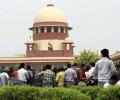
A group of lawyers and activists have petitioned the Chief Justice of India to retract recent Supreme Court remarks that cast doubt on the legitimacy of environmental pleas against developmental projects.

The Supreme Court has stated that a complete ban on pellet guns is not possible as long as existing advisories permit their use for crowd control in exceptional circumstances by security agencies. However, the court clarified that allegations of specific misuse can be examined on a case-by-case basis, particularly in light of recent protests against the NEET paper leak.

Amit Malviya paid the price because he committed the cardinal mistake of himself 'becoming' the BJP's IT Cell and its social media. Malviya's removal contains a message to others -- never try to become bigger than the job that has been assigned, explains Nilanjan Mukhopadhyay.
The Supreme Court has scheduled a July hearing for the Rs 500 crore money decree case involving Ras Al Khaimah Investment Authority (RAKIA) and industrialist Nimmagadda Prasad, following the failure of a mediation process led by former Chief Justice of India U U Lalit.
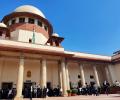
The Supreme Court has granted four weeks of protection from arrest to Bihar-based contractor Rishu Shree, who is accused of acting as a middleman in government tender manipulation. Shree is alleged to have charged commissions to facilitate contracts, with the Enforcement Directorate investigating a "larger conspiracy" involving multiple Bihar departments.
